
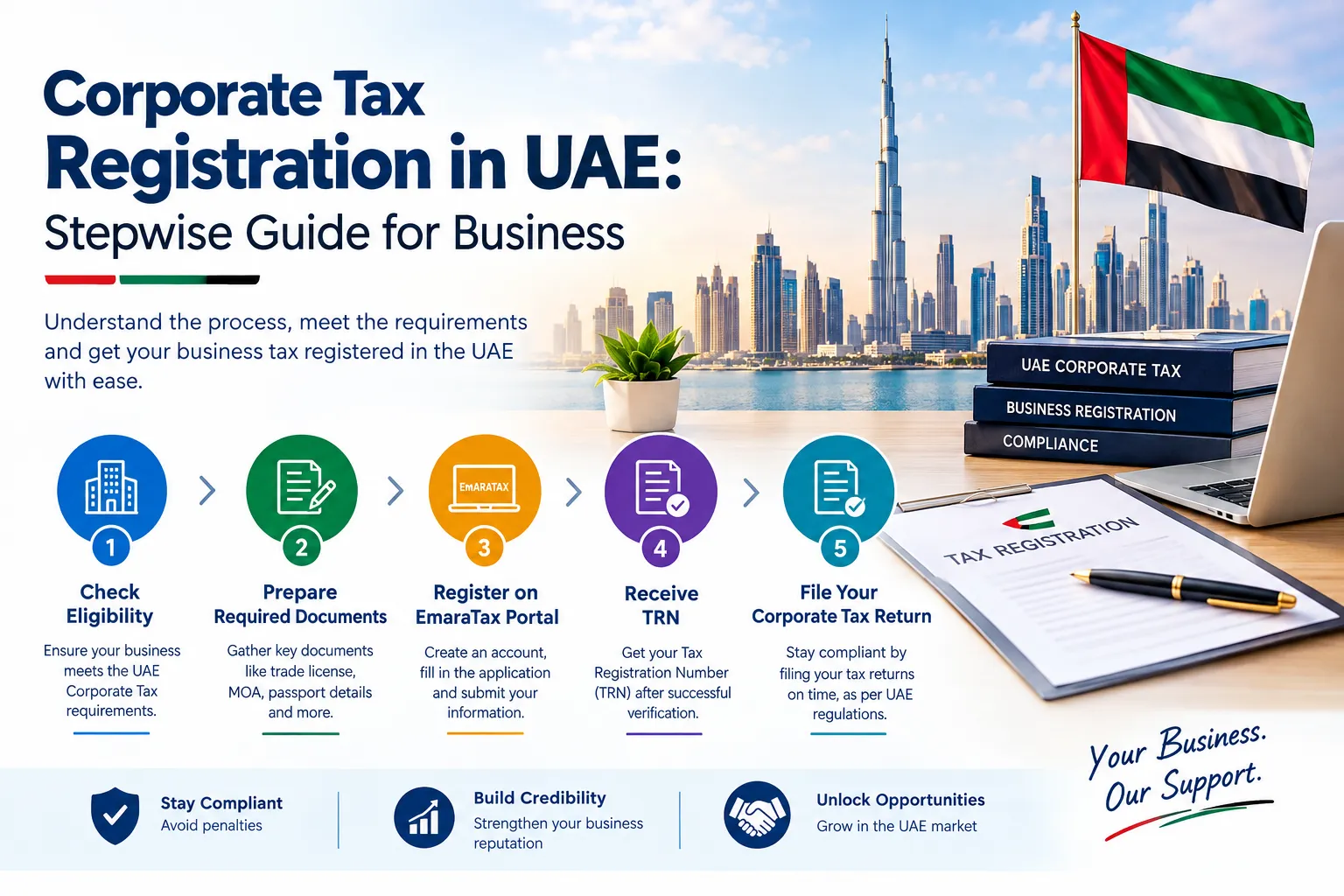
The United Arab Emirates has revealed a federal corporate tax framework, and businesses need to understand their tax obligations and keep accurate financial records. In the case of Dubai companies, a proper registration is an important step toward the fulfillment of the applicable tax compliance requirements.
Corporate Tax Registration UAE is the process of registering an eligible taxable person with the Federal Tax Authority (FTA) to obtain a Corporate Tax Registration Number. Registration is done on the FTA’s EmaraTax platform, according to the relevant rules and requirements.
If you run a mainland company, free zone business, branch or small enterprise, it is important to know whether your business needs to be registered, what documents are required, and when to submit your application.
Eligibility criteria: required documents Online application process Common mistakes and practical tips for business compliance in Dubai This guide
What is the Corporate Tax Registration in the UAE?
Corporate tax registration is the procedure by which a person subject to registration under the UAE corporate tax legislation applies to the FTA. Once approved, the business is issued a Corporate Tax Registration Number for any tax-related transactions.
Registration is a process separate from filing a corporate tax return or paying tax. According to the circumstances of the business, separate obligations can include preparing financial statements, keeping records, filing returns, paying the tax due, and updating information when relevant details change.
Businesses should not assume that they only need to register when they start to make a profit. The requirement to register will depend on the applicable law, the person’s status, and any relevant FTA decisions.
For companies seeking to get Corporate Tax Registration in the UAE, understanding these differences early on can help avoid missed deadlines and avoidable compliance challenges.
Who should register for corporate tax in the UAE?
The registration requirement is dependent on the legal structure, business activities, residency status, and applicable exemptions.
1. Companies in Mainland
Companies with trade licenses in the UAE mainland will need to register with the FTA. Their registration requirements depend on their legal status and the corporate tax rules applicable to them.
2. Free Zone Company
Businesses in the free zone should not assume that they are exempt from registration. Being in a free zone does not automatically absolve you of all corporate tax obligations, but a qualifying free zone person may be entitled to a special tax treatment if the relevant conditions are satisfied.
Businesses should check their activities, income, records, and eligibility before determining how the rules apply.
3. Branches and foreign companies in UAE
Foreign companies operating in the UAE may be required to register if they meet the relevant criteria, such as having a taxable presence in the country. The treatment of a branch depends on its relationship with head office and applicable legal provisions.
4. Persons Engaging in Business Activities
Natural persons undertaking business or business activities in the UAE may be required to register if their annual business turnover exceeds the relevant threshold. The general rule currently sets the threshold at AED 1 million in turnover during a Gregorian calendar year, subject to the relevant exclusions and rules.
Salary income, income from personal investments, and income from qualifying real estate investments are generally not included in the calculation for this purpose.
Conditions might be different in each category. Check your position against the latest FTA guidance before applying.
Documents Required for Company Tax Registration in UAE
Having the right documents prepared before you apply can help to reduce delays. The exact checklist will depend on the legal form and circumstances of the applicant.
People usually ask for things like:
• Valid trade license: A current license issued by the relevant licensing authority, including branch licenses where applicable.
• Certificate of incorporation or establishment: This could be a certificate of incorporation, memorandum of association, or partnership agreement (as applicable).
•Commercial registration documents: Official records issued by the relevant authority, where required.
• Passport & Emirates ID: A copy of the identification documents of the relevant owners and authorized signatories as requested by the FTA
• Authorization documents: Proof that the person submitting the application is authorized to act on behalf of the business.
• Company ownership information—You may need to provide information about shareholders and other relevant persons to complete the application.
• Other supporting documents: They may be required depending on the applicant’s structure or situation.
Make sure names, registration details, licence information, and other entries are consistent across documents. Please upload clear files in the accepted format and comply with the document-size restrictions indicated on the portal.
Always refer to the FTA official service page for the latest document checklist before you begin with the application for Corporate Tax Registration UAE.
Stepwise Procedure for Corporate Tax Registration in UAE
The FTA offers an online corporate tax registration service via its EmaraTax platform. The general procedure is:
Step 1: Open an EmaraTax Account.
Visit the official FTA page for corporate tax registration and use the EmaraTax service. Create an account and activate it if you don’t have one.
Make sure to use accurate contact information so that you can get notifications and respond to requests for more information.
Step 2: Profile of Taxable Person
Once logged in, navigate to the account dashboard and create a new taxable person profile, if applicable. Please enter the relevant business details carefully.
Please confirm the legal name, license information, business structure, and any other requested information before moving forward.
Step 3: Go to the Corporate Tax Registration Service.
Go to the relevant taxable person account and select the Corporate Tax registration option. The portal will direct you to the correct areas of the application.
Step 4: Fill Out the Application
Provide details of the business, its legal status, and other information as required. The fields displayed may vary from applicant type to applicant type.
Check all entries before submitting. Incorrect information may lead to a request for clarification or further processing.
Step 5: Upload Supporting Documentation
Attach the documents required by the FTA. All files must be readable, up to date, and properly filed under the appropriate section of the application.
Step 6. Review and submit
Look at the application for missing information and inconsistencies. Submit it through the portal and keep the application reference or acknowledgment for your records.
Step 7: Test the Application
• Monitor your EmaraTax account for status updates and respond promptly if the FTA asks for more documents or clarification.
The FTA estimates the application takes 25 minutes to complete, and once the authority receives a completed application, it takes about 20 business days for the authority to process. In practice, this may vary depending on the application and any additional information needed.
Corporate Tax Registration Filing Deadlines and Penalties
The registration deadline varies by type of taxable person, the date of establishment of the entity, the licensing circumstances, and the FTA decisions applicable. There’s no one deadline that works for all businesses.
It is important for companies to determine the registration timeline relevant to their own category and not to just take the general summary on the Internet. The FTA has also issued revised rulings and clarifications, so companies should check the latest requirements before taking action.
Late registration may be subject to an administrative penalty. The FTA’s current corporate tax registration service carries a fine of AED 10,000 for late registration, subject to applicable rules and relief provisions.
The FTA also provides for a penalty waiver for late registration, which is conditional upon the filing of the first tax return or applicable annual declaration on time within the specified period. Don’t assume that a waiver automatically applies; instead, review the official terms.
Common Mistakes Companies Should Avoid
In the case of businesses, overlooking simple administrative details can complicate the registration process.
• Failed to meet the deadline: Locate the deadline for your specific business category.
• Incomplete paper submissions: Please check the official checklist for uploading files.
• Entering inconsistent information: Ensure business and license details match official records.
• Free zone status = automatic exemption (review registration and tax treatment separately).
• Not complying with post-registration requirements: Registration does not relieve you of your obligation to file returns, pay, or keep records.
• Do not watch the portal: Timely response to FTA requests and retention of copies of important notices.
Good financial records and a clear compliance calendar can help businesses to handle these responsibilities more effectively.
How Professional Support Can Help Dubai Businesses
It can be a time-consuming process for new companies and businesses with complex ownership structures to understand the rules for registration, prepare the documents, and keep track of deadlines.
Professional support can help businesses get organized with their documents, understand the requirements, and get ready for tax compliance. Before you work with an adviser, check what services are offered, what the fees will be, and whether any regulated tax services will be provided by an appropriately authorized professional.
Businesses interested in supporting Corporate Tax Registration in the UAE can visit ProHub Abu Dhabi to learn about available information and services. The FTA has the ultimate authority to decide on registration and application processing.
Conclusion
Corporate tax compliance is a key responsibility for qualifying businesses in Dubai and the UAE. Businesses can approach their obligations with greater confidence by knowing the registration rules, gathering the correct documents, and following the EmaraTax process.
Important Steps for Corporate Tax Registration in the UAE are Eligibility Verification, knowing the Right Deadline, providing correct information, and tracking the application on the Official Portal. Businesses should also anticipate continuing duties such as record-keeping and filing of tax returns, where applicable.
Registration timelines and regulatory guidance are subject to change, so you should always consult the most recent FTA information or seek appropriate professional advice before making a compliance decision.
Frequently Asked Question?
1. What is meant by corporate tax registration in the UAE?
It is the registration of a person who is obliged to register under the UAE corporate tax legislation with the Federal Tax Authority. A Corporate Tax Registration Number is generated upon successful registration.
2. Who is required to register for corporate tax in Dubai?
Many companies from the mainland and free zones, as well as other taxable persons, are required to register in terms of the applicable rules. Some natural persons who carry out business activities may also be required to register if they exceed the relevant turnover threshold.
3. How to apply for corporate tax registration in the UAE?
The application is submitted through the FTA’s EmaraTax platform. In general, applicants will create or access an account, create a taxable person profile, complete the corporate tax registration application, upload documents, and submit for review.
4. How long does it take to get a corporate tax registration in the UAE?
The FTA estimates that it takes 20 business days to process a completed application. Actual time may vary if we require more information or documentation.
5. Is there a late registration penalty for corporate tax in the UAE?
Currently, the FTA mentions an administrative penalty of AED 10,000 for late registration, subject to applicable rules and relief provisions. Check your deadline and the conditions of any waiver initiative that may be available.
6. Is corporate tax registration required for a free zone company?
Companies in free zones should check their registration obligations and not assume that they are exempt. If the relevant conditions are met, a qualifying free zone person can be entitled to special tax treatment, but registration and compliance requirements must be checked separately.
Planning a Business or Legal Process in the UAE?
Get direct expert guidance for business setup and complete corporate PRO services in Abu Dhabi.
Comments (0)
Loading comments...